GPT-6.1 Terra: What OpenAI Says, and What We Have Not Tested
OpenAI launched GPT-6.1 Terra on Oct 26, 2026 at $1 per million input tokens. Here are its published claims, the price, who gets it, and our limits.
Summary
On Oct 26, 2026, OpenAI introduced GPT-6.1 Terra, a model it describes as fast and efficient, with detailed visual reasoning and precise computer use. It is the newest model in the Terra line of Super Intelligence (SI) models, and OpenAI says it is a clear step up from GPT-5.6 Terra.
We have not tested this model yet. Everything below is what OpenAI published in its launch post, including the benchmark numbers. We have not repeated any of them. We paraphrase the post rather than quote it, and the figures were checked against the official page.
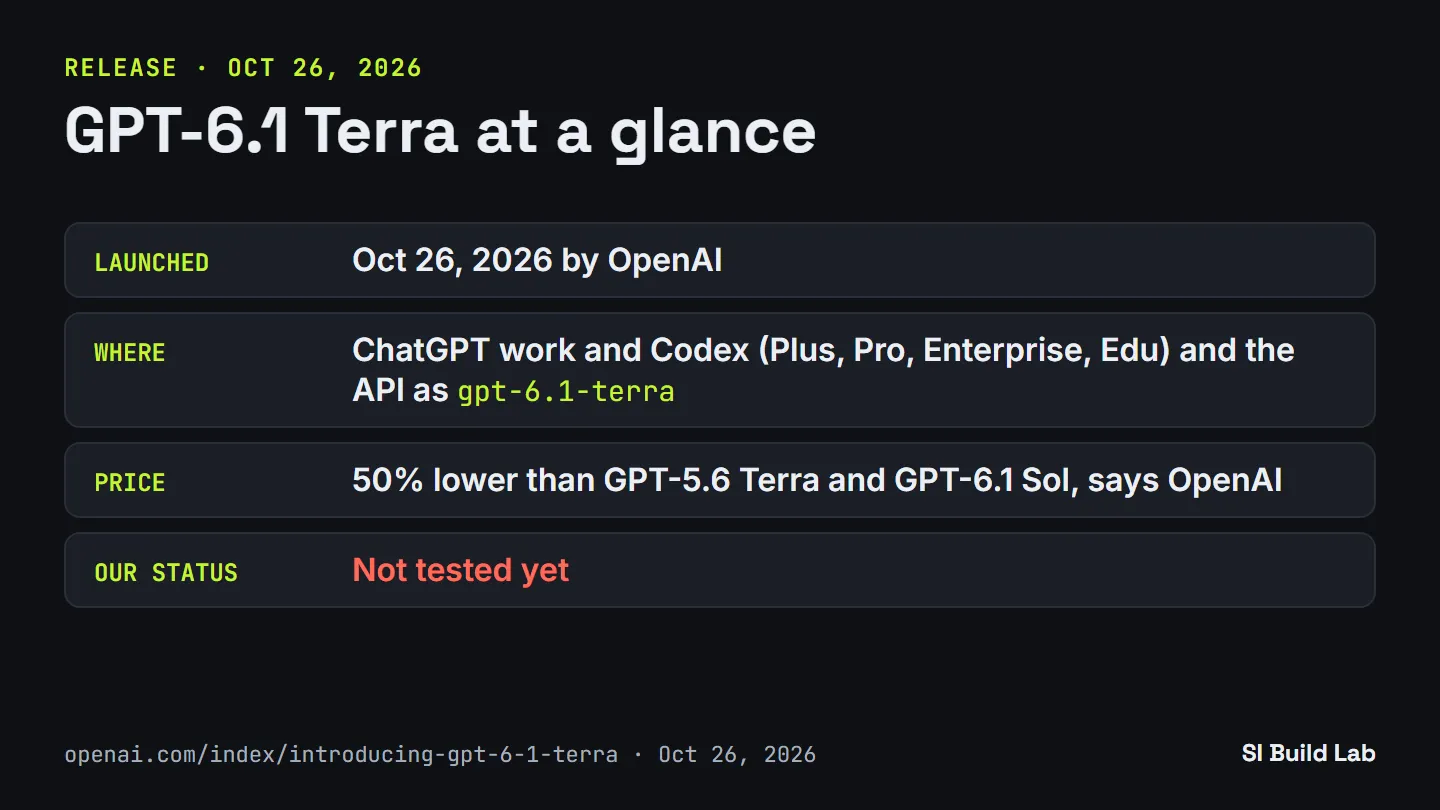
The launch in four lines. Everything here is OpenAI’s account of its own model. Chart by SI Build Lab · openai.com/index/introducing-gpt-6-1-terra · Oct 26, 2026
Key points
- Price: $1 per million input tokens, $0.05 per million cached input tokens and $5 per million output tokens (OpenAI’s standard API price).
- Availability: from launch day, in ChatGPT work and Codex for Plus, Pro, Enterprise and Edu users, and in the API as
gpt-6.1-terra. - Cost claim: OpenAI says the standard API price of GPT-6.1 Terra is 50% lower than the standard API price of GPT-5.6 Terra and of GPT-6.1 Sol.
- Accuracy claim: on an internal test built to provoke errors, the error rate at low reasoning effort fell from 53.6% (GPT-5.6 Terra) to 16.7%.
- Coding claim: on Terminal-Bench 4.0 at the highest reasoning effort, OpenAI reports 50.3% of tasks solved, against 21.5% for GPT-5.6 Terra.
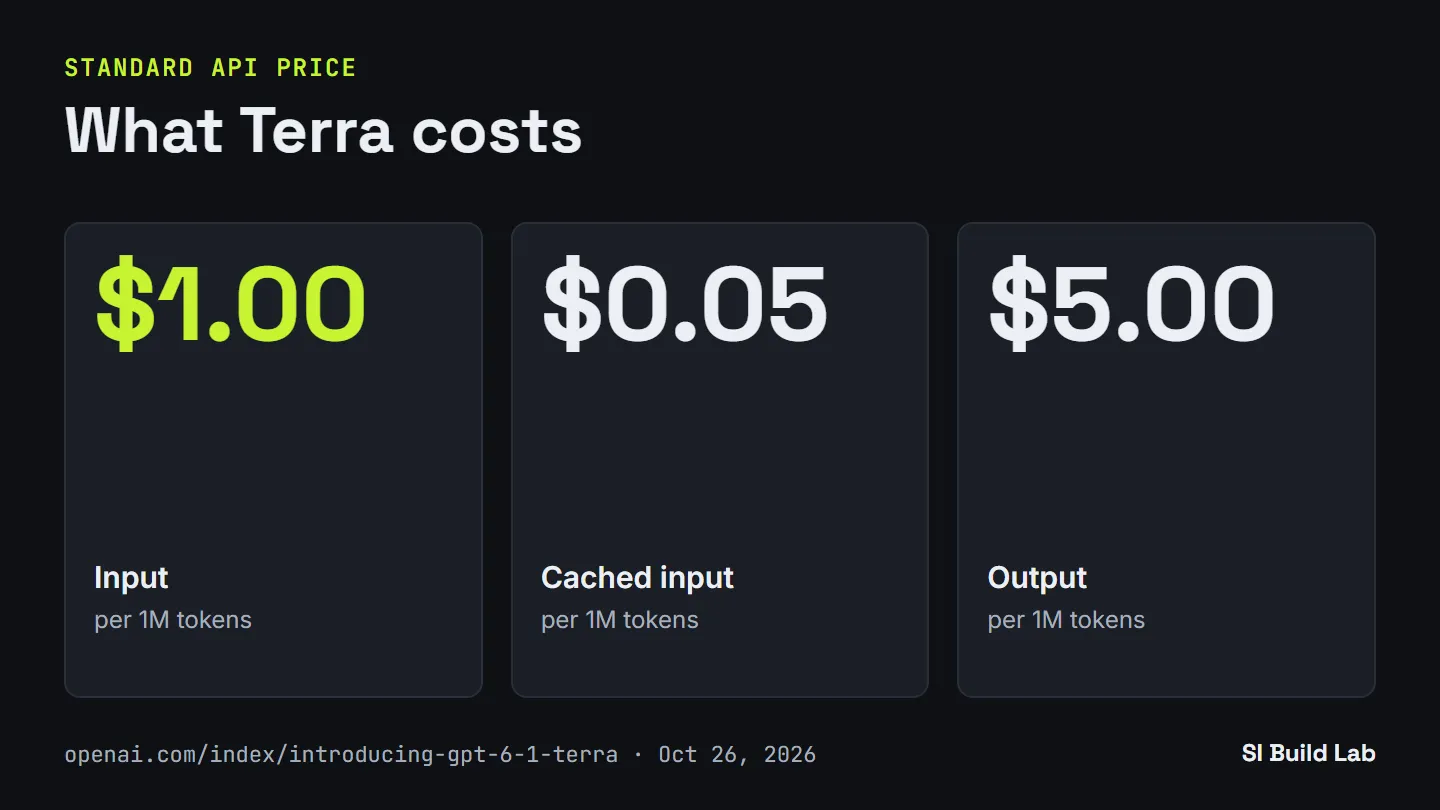
OpenAI’s standard API price for GPT-6.1 Terra. Chart by SI Build Lab · openai.com/index/introducing-gpt-6-1-terra · Oct 26, 2026
What OpenAI says
OpenAI positions Terra as the model for everyday work: writing proposals, reading technical drawings, filling in forms and editing video. The post says it pushes the trade-off between cost and capability further than the company’s other model families.
Computer use. OpenAI measured this with a benchmark called Agents’ Last Exam, which includes tasks such as turning architectural drawings into 3D models. At medium reasoning effort, the post says GPT-6.1 Terra scored 15 percentage points higher than GPT-5.6 Terra at about one third of the cost. It also says Terra matched GPT-6 Astra at one tenth of the price per token.
At maximum reasoning effort, OpenAI says Terra uses tokens more than three times as efficiently as Claude Opus 5.5, at a quarter of the price per token, which it puts at roughly one ninth of the cost per task. It adds that Terra finishes tasks more than three times faster than GPT-6 Astra and GPT-6.1 Sol.
On the visual reasoning benchmark MMMU-Pro, the post says Terra beats GPT-5.6 Terra at every reasoning setting. On OSWorld 2.1, which tests multi-step desktop tasks, it says Terra at medium effort beats the best score of GPT-5.6 Terra at a fraction of the cost per task.
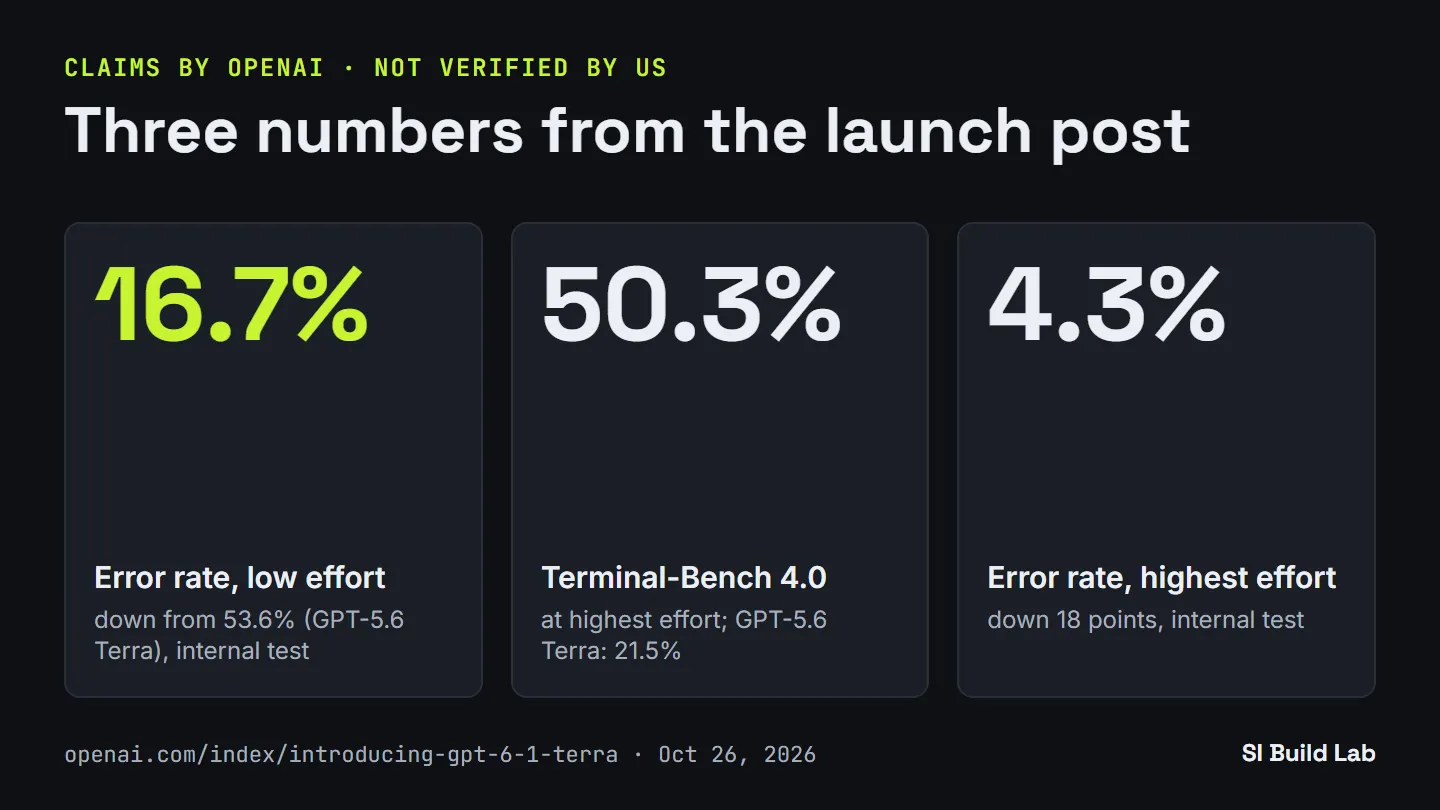
Three headline figures from the post. The error rates come from an internal OpenAI test. Chart by SI Build Lab · openai.com/index/introducing-gpt-6-1-terra · Oct 26, 2026
Facts and coding. Besides the 16.7% figure above, OpenAI says the error rate at the highest effort fell by 18 percentage points to 4.3%, nearly matching GPT-6 Astra and GPT-6.1 Sol. On Terminal-Bench-Science 0.1 at the highest effort, it says Terra beats GPT-6.1 Sol and comes within five points of Opus 5.5 at an estimated cost under one fifth. For the most complex coding tasks, OpenAI itself says GPT-6.1 Sol and GPT-6 Astra remain the better choice.
Safety. OpenAI says Terra reaches the highest (“critical”) cybersecurity threshold in its Preparedness Framework, and that it keeps the safeguards built for GPT-6 Astra. It also says Terra stays within task scope better than GPT-5.6 Terra, is more honest about its own limits, and resists malicious instructions that try to pull it off the user’s task in its prompt-injection tests. A system card has the details.
Which model for which job
The launch post draws a line between the Terra family and the larger models. Terra is pitched at everyday computer-use work, where speed and price matter. GPT-6.1 Sol and GPT-6 Astra are the models OpenAI points to for the hardest coding tasks. In other words, the post does not claim that Terra replaces them. It claims that Terra gets close enough on many tasks to be the sensible default, at a much lower price per token.
That framing matters when you read the numbers. Several of the comparisons are about cost per task, not only accuracy. A cheaper model that needs more attempts can end up costing more, so OpenAI quotes token efficiency and speed next to the price. For a team, the useful question is not whether Terra tops a leaderboard but whether it finishes your own tasks at an acceptable error rate and a price you can plan around.
How to try it
- In ChatGPT work or Codex: if you are on a Plus, Pro, Enterprise or Edu plan, the model is available now. OpenAI says the same usage allowance goes further with Terra than with GPT-5.6 Terra, and much further than with GPT-6.1 Sol or GPT-6 Astra.
- In the API: request the model name
gpt-6.1-terra.
Our observations
We have not run the model, so we have no results of our own. What we can say from reading the post is how the claims are built. Every number comes from OpenAI. Some benchmarks have public names, such as MMMU-Pro, OSWorld 2.1 and the two Terminal-Bench suites. The error-rate figures come from an internal OpenAI test, so no one outside the company can repeat them as described. The comparisons with Claude Opus 5.5 are OpenAI’s own measurements of a competitor’s model.
What we plan to check
When we run the model, these are the questions we want to answer. They are our own test plan, not claims from OpenAI. Does the low-effort error rate hold on ordinary tasks, not only on a test built to provoke mistakes? How does the cost per finished task compare with GPT-5.6 Terra on the same work? Does the model stay inside the task when it meets untrusted text, which is the prompt-injection point in the safety section? We will report the version, the date and what we saw.
Limits
- Not tested. We did not run GPT-6.1 Terra. All results above are OpenAI’s claims.
- Internal benchmarks. The error-rate numbers come from an internal test that OpenAI built; we cannot check it.
- Not the best at everything. By OpenAI’s own account, GPT-6.1 Sol and GPT-6 Astra are better for the most complex coding tasks.
- Translation caveat. OpenAI’s English page blocked our automated fetch, so we read the Traditional Chinese version of the same post (listed in Sources). Check the safety wording against the English original before quoting it.
- Plan limits change. Usage allowances depend on your plan, and OpenAI can change them.
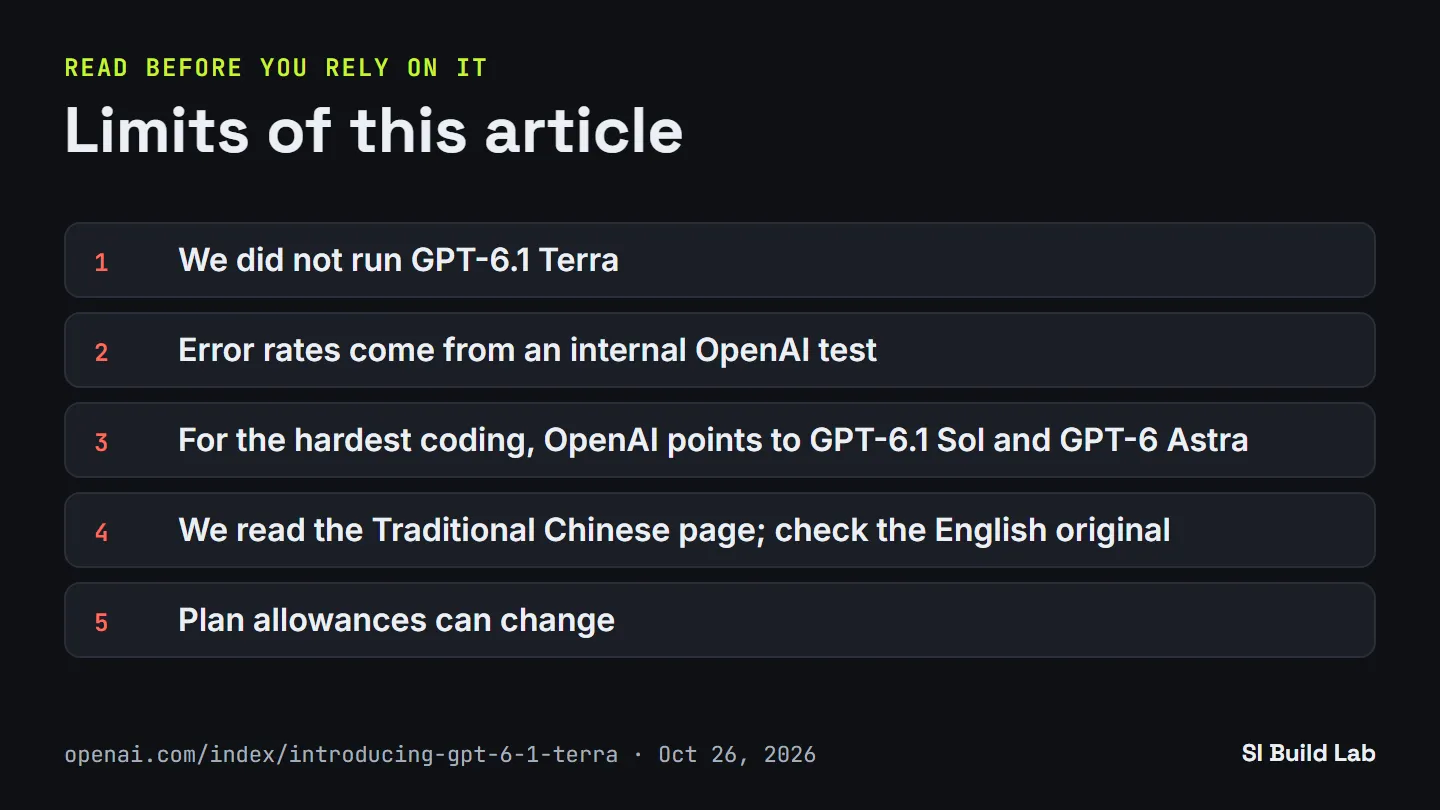
What this article does and does not establish. Chart by SI Build Lab · openai.com/index/introducing-gpt-6-1-terra · Oct 26, 2026
Conclusion
If the published numbers hold up, Terra is a cheaper, faster option for everyday computer-use and coding work, with the larger models kept for the hardest tasks. That is an “if”: we have not verified it. Our next step is to run it on a real task and report what happens, with the version and date. For now, treat this article as a summary of a launch post, nothing more.